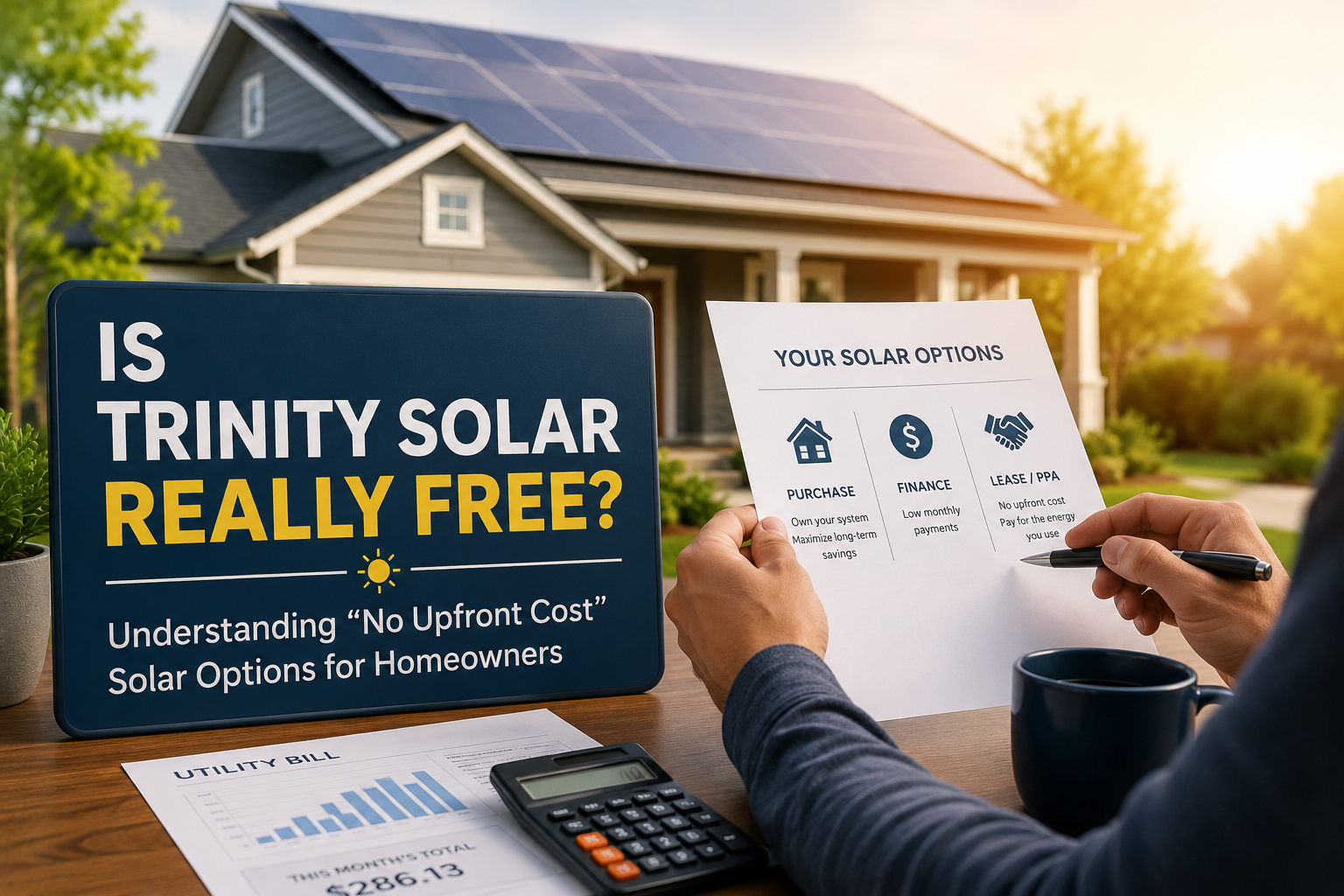
Is Trinity Solar really free?
Quick answer: No solar system is completely free. However, many homeowners qualify for payment options that require little or no upfront investment. The best option depends on your financial goals, energy usage, location and whether you want to own the system or pay for the electricity it produces.
If you have researched solar online, you have probably seen ads promising “free solar panels.”
It sounds appealing, but it is also one of the biggest sources of confusion for homeowners.
The reality is that “free solar” usually refers to payment options that reduce or eliminate the upfront installation cost. It does not mean the equipment has no value, there is no agreement or you will never pay anything.
Understanding the difference can help you compare solar options more confidently and avoid surprises later.
Why do companies advertise “free solar”?
Many homeowners assume they need tens of thousands of dollars available before they can consider solar.
That is not always the case.
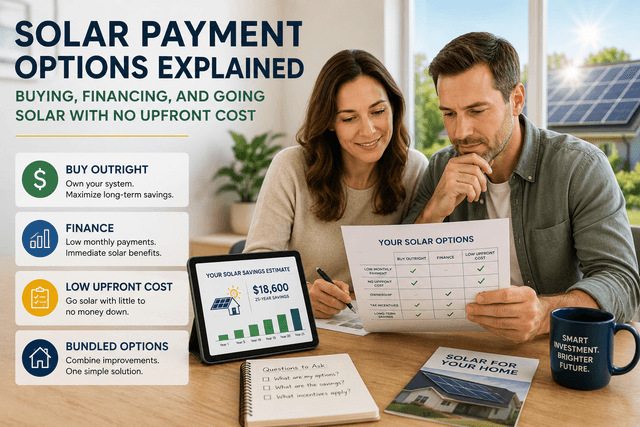
Solar companies often use “free solar” language to describe programs that make it possible to go solar with little or no money paid upfront. Depending on the program, homeowners may still make monthly payments, pay for the electricity produced or enter into a long-term agreement.
Important: “No upfront cost” and “free” are not the same thing. A no-upfront-cost option may remove the initial payment, but homeowners should still review ownership, monthly costs, contract terms and long-term value.
If you are comparing payment methods, our guide to solar payment options explains how different structures work.
What does “no upfront cost” actually mean?
A no-upfront-cost solar option means you may not have to pay the full installation cost before your system is installed.
Instead, costs may be handled through financing, a lease, a power purchase agreement or another payment structure.
| Solar option | Upfront cost | Who usually owns the system? |
|---|---|---|
| Cash purchase | Usually highest | Homeowner |
| Solar financing | Often low or none, depending on approval and terms | Homeowner, depending on financing structure |
| Lease | Often low or none | Solar provider or third party |
| Power purchase agreement | Often low or none | Solar provider or third party |
The key is understanding what you are agreeing to. A low upfront cost may be helpful, but it should still be evaluated alongside monthly payments, ownership, contract terms and long-term savings potential.
How Trinity Solar payment options can work
Trinity Solar may offer multiple ways for homeowners to move forward, depending on location, eligibility and available programs.
Common options may include purchasing a system, financing solar over time or choosing a lease or power purchase agreement. The right option depends on your financial goals and how you want to think about ownership.
Purchase
Often best for homeowners who want full ownership and stronger long-term savings potential.
Financing
Can spread solar costs over time and reduce the need for a large upfront payment.
Lease
Can allow homeowners to use solar without owning the equipment directly.
Power purchase agreement
Usually means paying for the electricity the system produces rather than buying the system itself.
To understand how these options affect the bigger cost picture, read our guide on how much Trinity Solar costs.
Is “free solar” the same as government-funded solar?
No. “Free solar” is usually not a government giveaway.
Solar incentives and state programs may improve the financial picture, but they do not mean every homeowner automatically receives a free system. Eligibility depends on location, utility provider, tax situation, system design and current program rules.
In some states, utility programs or solar credits may help reduce long-term energy costs. In others, incentives may work differently or change over time.
If you live in Connecticut, our guide to going solar in Connecticut explains how state programs work. If you live in New Jersey, our guide to going solar in New Jersey covers the local solar landscape there.
What about the federal solar tax credit?
The federal Residential Clean Energy Credit previously helped many homeowners reduce the cost of going solar. However, current IRS guidance says the credit is not available for residential clean energy property placed in service after December 31, 2025.
Important: Homeowners should not assume a federal solar tax credit applies to a new solar installation without confirming current eligibility with a qualified tax professional.
For more background, see our guide to the Federal solar tax credit.
Common misconceptions about “free solar”
The phrase “free solar” can create confusion because homeowners may hear different versions of the same claim.
| Misconception | Reality |
|---|---|
| Solar panels are completely free. | Most “free solar” offers refer to payment structures, not free equipment. |
| Every homeowner qualifies. | Eligibility depends on the home, roof, location, credit qualifications and available programs. |
| No upfront cost means no cost ever. | No upfront cost usually means costs are handled through another payment or agreement structure. |
| All solar payment options are the same. | Purchase, financing, lease and power purchase agreement options can have very different long-term outcomes. |
Should you buy, finance or lease solar?
There is no universal answer.
Some homeowners prioritize the lowest upfront cost. Others want stronger long-term savings or full ownership. Some want predictable monthly payments. Others want to reduce utility dependence without taking on the same ownership responsibilities.
Before choosing a solar payment option, ask:
1. Do I want to own the system?
2. How important is low upfront cost?
3. What monthly payment fits my budget?
4. How long do I plan to stay in the home?
5. What happens if I sell the home?
6. How does this compare with my current and future utility costs?
The best option is not always the one that sounds cheapest upfront. It is the one that fits your home, your budget and your long-term energy goals.
How solar can still lower electric bills
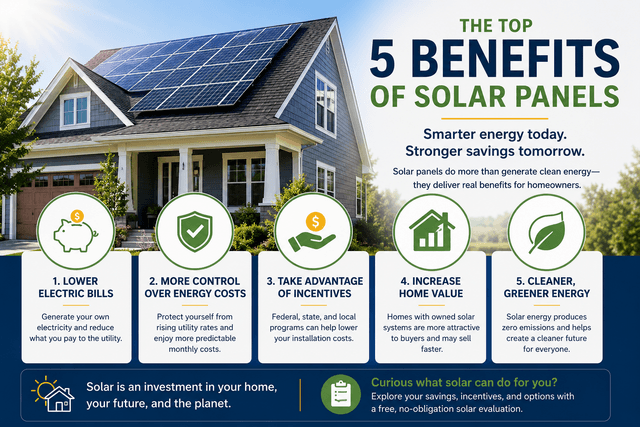
Solar may not be free, but it can still help homeowners reduce how much electricity they buy from the utility.
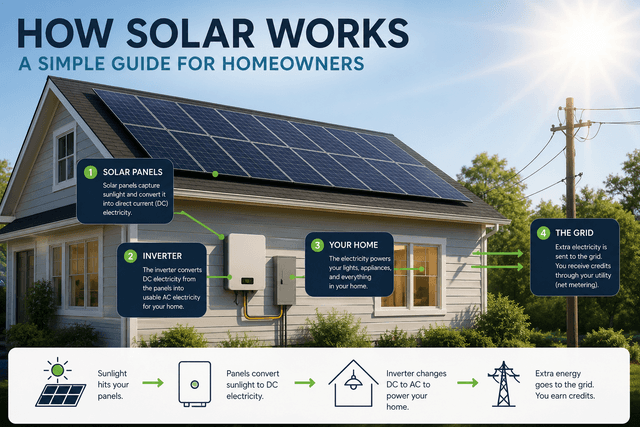
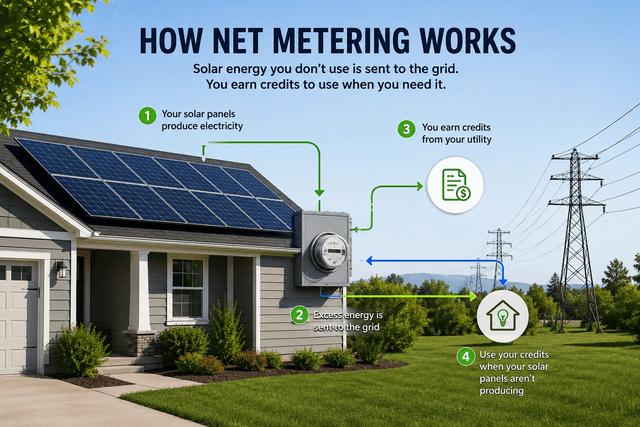
When your solar panels produce electricity, your home can use that power first. If your system produces more electricity than your home needs at a given time, extra energy may be handled through your utility program, depending on your state and provider.
That is one reason homeowners often compare solar against future utility costs, not just today’s electric bill.
Our guide on solar vs. utility costs explains how homeowners compare the long-term cost of staying fully with the utility versus producing some of their own electricity.
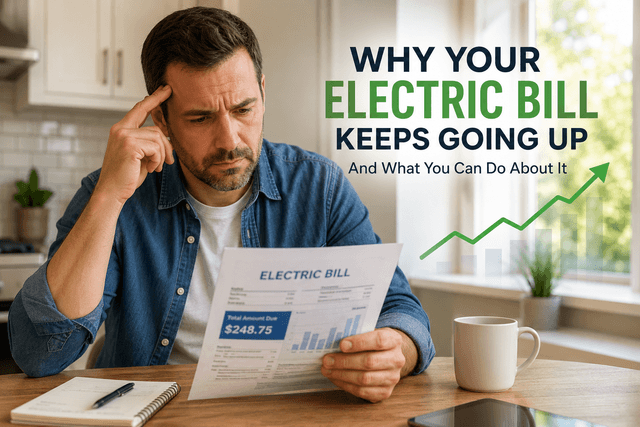
If your electric bill keeps rising, our article on why your electric bill keeps going up explains the larger forces behind utility cost increases.
The better question is not “Is solar free?”
A better question is:
Which solar payment option makes the most sense for my home?
That is where a personalized evaluation becomes valuable.
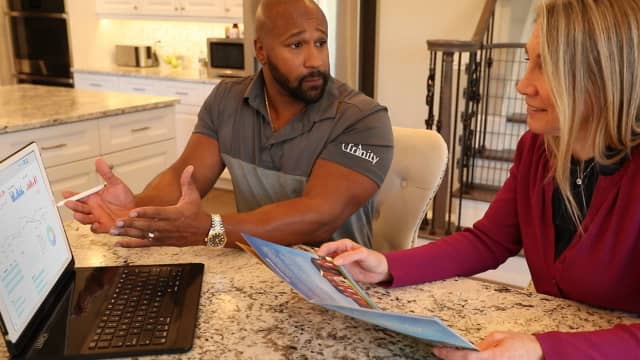
Instead of relying on ads or statewide averages, homeowners can compare options based on roof layout, electric usage, available programs, utility costs and long-term goals.
Understanding your options is more useful than chasing the word “free.”
The right solar payment option is the one that fits your home, your budget and your long-term energy goals.
Continue learning
If you are comparing solar costs, payment options and long-term savings, these guides are a good next step: